New Tech isn't Sci Fi, it's Monopoly
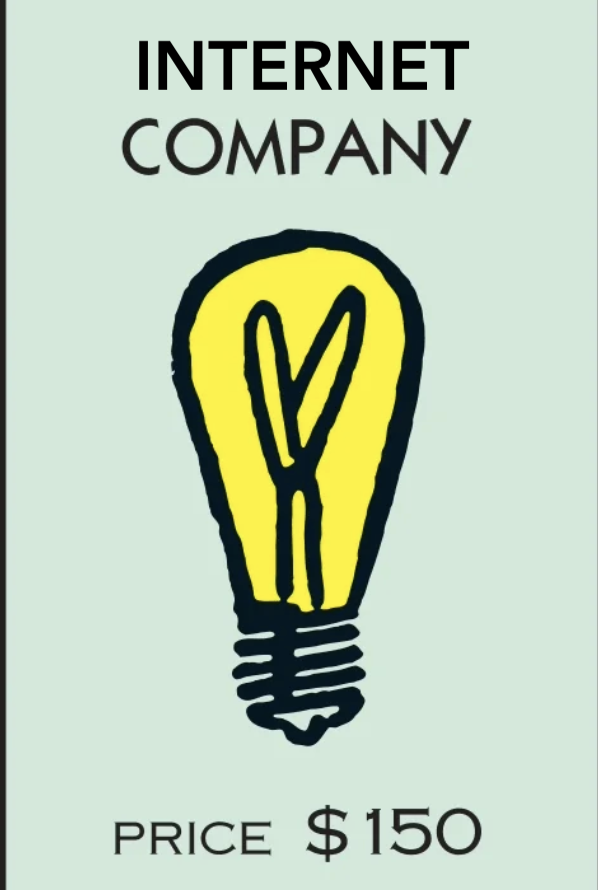
If I had wanted a happy family game night, I shouldn’t have chosen Monopoly. Everything was civil at first. The kids bought up the colorful properties until a balance of power was struck midway through the game. From there they happily swapped cards, planned their hotels, practiced counting out change.
Enough with the gentility. My husband swooped in, determined to show them just how dysfunctional a society based entirely on monopolistic capitalism could truly be. I watched him scoop up card after card, leaving their real estate mogul ambitions in the dust and each of them sobbing on the floor.
Amid the disarray, I noticed something. The kid that owned two of the rail lines and an electric company held the line against the hungry real estate giant the longest. If they had held all four railroads and both utilities, it would have been game over—against my husband. Don’t get distracted by real estate. Own the pipes, and property titans are subject to you, not the other way around.
Monopoly speaks to us from a time when Park Place and Atlantic City were the hottest Gilded Age developments and the railway barons were busy building their empires of steel. Andrew Carnegie’s investors struck it rich when he bought up the steel mines and mills that supplied the rails, benefiting from vertical integration and preferred pricing. Meanwhile, mega-corporations like General Electric bought up shares in local power grids and utility companies. They used their enormous scale to flood the market with electrical appliances that spoke of the future to the 1920’s housewife even as they increased her household’s reliance on the very grids they owned.1 Double payout.
These companies and individuals operated outside the scope of regulation. The government raced to catch up, even as elected officials lined their pockets with stock market success. Inequality increased until the economy teetered on the precipice of the greatest depression yet seen. The ensuing “dustbowl” saw millions of formerly comfortable households out of work.
The resonances are stark. So are the rules of the game. In a monopoly, there is little that governance can do to rein these forces in. The goal is not to play nice. Own the pipes, and you own the board.
What's the Deal with Space?
When Paypal billionaire Elon Musk started Space-X and Amazon billionaire Jeff Bezos started Blue Origin, many people were perplexed. What did these internet moguls know about space? Was this just the fantasy of a youth spent poring over Star Trek and cheap scifi? One might easily get that impression from Elon’s glib statements about living on Mars, or Lauren Sanchez’s skin-tight “spacesuit.” It looked like Barbarella-style pulp fiction from the sixties, frozen in time, retrograde.
When these two billionaires bought Twitter and the Washington Post, it seemed equally incomprehensible. Experts suspected they were over-extending themselves. Perhaps they were amassing a portfolio of corporations across industries. Those in the know found them utterly inattentive to what is truly required to run a media venture: the trust and safety, the truth in reporting.
But these men are playing a different game, not unlike the one Andrew Carnegie or General Electric played a hundred years ago. This is monopoly, and they are playing to own the pipes.
Bringing launch capacity back to the United States under private companies has been a tremendous achievement, to be sure. Yet the twenty-first century space race is not like the twentieth. That’s because space is the new railroad.
Access to near Earth orbit is an essential conduit for our GPS systems, our next generation of global internet. Space-based communications will link together our next global political economy. Developing launch, data and communications capabilities all in house is an infrastructuring project on its way to the literal and financial stratosphere.
Owning access to space is a way to leapfrog the mundane worlds governed by American regulation overseeing telecommunications, media, internet. It is the ultimate “Get Out Of Jail Free” card for our current material worlds dominated by players like Comcast or Verizon, Lockheed or Boeing, Time Warner or AT&T.
It is also a convergence project. PayPal and Amazon were about creating one unavoidable infrastructure, like online payment or delivery logistics. Rolling together ecosystems for launch, telecom, news, and data is a project like Carnegie’s mines, mills, and production lines. That’s not a diversified portfolio: it’s a consolidated one.
It is not the science fiction vision of life off-world that draws these men to spaceflight, although they dangle those visions in front of our eyes like a distraction. It is a far more mundane vision encapsulated in a Gilded Age board game. Own the pipes, and your vertically integrated stack becomes the necessary conduit, without which other systems (the railroad, government, or AI) cannot function. Own the pipes, and you own the board.
Space and Power
Space is not empty. It’s not just about the masses of space junk, the aging achievement of the International Space Station, the Starlink satellites disintegrating into toxic dust swirling in our upper stratosphere. Space is actually governed, by international regulations. These rules were imposed largely by the United States to ensure its continued supremacy off-world.
As the space age got its start, the importance of access to points of geosynchronous orbit became clear for global positioning, communications, military and spy applications. The vast majority of satellites needed to orbit in one band close to the equator to be maximally effective. Equatorial countries long overlooked in the global world order who had endured the staging grounds for European colonial interests now saw their chance. If the laws of the sea or the air applied to space, then they could claim the stratospheric airspace above their countries as part of their sovereign territory. They could even charge more powerful countries for passage.
This was unacceptable to the world superpowers, who argued instead for an international space treaty based on territorial neutrality. That is, no one could claim space as a territory. With lofty language about representing “all mankind,” this ensured enabled safe and free passage for anyone who could afford to get there, and continued suppression for those who could not.
For decades this law and a sense of space as a place to be preserved continued unabated. Access to space was managed not merely through the brute cost of entry, but through inter-governmental Memoranda of Understanding, treaties, peaceful collaboration among nations, and limited forms of technology transfer.
Now that the United States seeks to move its corporate ambitions off-world, these laws that make space appear so spacious lay the staging ground for monopolistic capture. Space is not just open, it’s open for business. And not through property or real estate, mind you, but through the infrastructures of access.
Access to space and communications is not just about profitability. It can also leapfrog international law. Musk’s personal decisions to switch Starlink access on or off over the war zone in the Ukraine has massive implications for geopolitical stakes.
No governance, no treaties, no peacemaking. Just the whims of capricious billionaires whose attention, sympathies, and calculations may change one moment to the next.
Billionaire Broligarchy
Space is hard. It is difficult to get there without blowing up millions of dollars of equipment on the launchpad, often in full public view. It is an unforgiving environment, more so than the American West whose expansion was blown into submission with dynamite, grit, and the erasure of nature and people in its path. The resources required to maintain an earth-to-space pipeline, let alone an economy, are vast.
Letting billionaires blow their own money into atmospheric dust particles instead of public sector dollars may seem like an appropriate use of funds. Such an idea makes it difficult to see why something as boring as governance should matter.
But before the world wars enabled America to nationalize the railroads and transform utility companies into at least partial public goods, the monopolists were price-setting and rent-seeking, gouging the everyday American and the state alike. It appeared their technologies, like their owners, were simply ungovernable.2 As decades of ensuing waffling between public and private ownership of these large infrastructures shows,3 accountability is not an ingredient you can merely add later.
That doesn’t mean it is impossible to build systems differently. In the twenty years I have spend working with scientists and engineers of NASA,4 their goal is expansive access, not ownership. They command robotic vehicles, launch systems and data conduits all in the public interest. Their everyday decisions are infused with a sense of loyalty to country effected through upholding the laws of spaceflight and ensuring the wonder of exploration is passed to the next generation. Their work weaves together the private and public sectors, as their earth-bound mission is to stimulate the economy, create more high skilled jobs and maintain technical literacy across the nation. Less Monopoly, more Star Trek, a vision of the best of humanity united, working together in space, regardless of color or creed, gender or (alien) race.
Commercial media also flourish under regulatory environments that permit speech and encourage and pro-social ideals. When he bought the Washington Post in 1933, Eugene Meyer explicitly oriented the daily rag toward truth-telling, public duty, and evading special interests. Like many others who founded newspapers in the United States who clung to the importance of the fifth estate, the first amendment, a free press, as constitutionally required by a democratic society, he and his followers truly believed that Democracy Dies in Darkness. Years later, a commercialized Internet allowed the idealists who started Twitter to build tools they believed would connect and democratize like never before. None of these people would recognize their systems today.
As we enter an era of full state retreat, the billionaires are claiming the next generation of railroads and utilities through spaceflight and communications. Unlike Star Trek, a sense of duty or public responsibility, these essential pipes are once more governed by responsibility to shareholders and by the whims of an unelected class. Adding AI or space-based data centers only extends this game, of injecting private and unaccountable infrastructures into the fabric of our lives, our workplaces, and our government.
Monopoly Via Tech Means
The game of monopoly being played all around us is now difficult to see. It is being played with invisible materials like ephemeral data, proprietary algorithms, or unworldly satellites. In a post-1930’s world of regulation in which singlecompanies are never again allowed to be too big to fail, America has settled for duopolies, as if two titanic incontrovertible giants locked in extended competition supported by the same shareholders offers any respite to the citizen-turned-customer.
We are increasingly seeing the rise of extended networks of erstwhile competitors, portfolio companies with subsidiaries. They swap lateral intergration for vertical, weaving many apparently distinct corporate pipelines into the same coffers by pledging each other data, chips, AI algorithms, data centers, and other promissory currencies besides.
Yet the drumbeat is the same, encapsulated best by yet another member of the PayPal Mafia, Peter Theil. “Competition is for losers,” he famously crowed. The era of benighted competition in a neoliberal marketplace is over. Own the market, set the prices, become the conduit, and no one can get in your way.
In space and on Earth, monopoly is the name of the game. And the way to win is to own the pipes. Knowing what game they are playing, by contrast, helps us thwart their intentions. If we want to resist, throw a monkey wrench into the works, we need to break that party up.
1Ruth Schwartz Cowan, “How the Refrigerator Got Its Hum,” in Shaping Technology, Building Society.
2Thomas M. Cooley, “The Railway Problem Defined,” Proceedings of National Convention of Railroad Commissioners, March 1891.
3Georg Rillinger, Failure By Design: The California Energy Crisis and the Limits of Market Planning. Chicago 2024.
4Janet Vertesi, Shaping Science: Organizations, Decisions, and Culture on NASA’s Teams, Chicago 2020.